House quiet. Phone warm in my hand. Just one look.
11:47 pm · everyone is asleep
You typed the truth.
Then you deleted it.
You told God, and yourself, that last night was the last time. This is the plan for tonight: what to do in the first ten minutes, who to tell, what to change in your room and on your phone, and how to get back up when you fall. Written for people who share a room, count data bundles, and cannot tell their pastor.
Get the 30-day plan · ₦5,000Instant PDF · discreet cover included
no one has to know
89pages
15chapters
29worksheets
30daily prompts
2rescue cards
2covers
What you are getting
One download. Everything for the first thirty days.
The guide, two rescue cards, twenty-nine worksheets, a prompt for every day, and a second cover that does not say what the book is about.
Numbers on the picture match the list further down.

The moment you know too well
A friend asks if you are okay.
Watch what happens to the truth.
How many times have you typed the truth… and deleted it?
01 The night
Let me tell you about a night you already know.
The house is finally quiet. Somebody is asleep on the other side of the room, or a television has gone silent down the corridor. The only light is the one in your hand.
You tell yourself it is just a quick look. You have told yourself that before, and you know exactly how it ends. You look anyway.
And then comes the part nobody sees: the silence afterwards. The relief drains out and the shame comes in, cold, all the way up your chest. You think about the voice that prayed beside you this morning. You think about the friend who texted “God bless you, you are such a light.” You turn the phone face down and whisper it again.
Never again.
Relief. Then the shame, cold, all the way up my chest.
I prayed. I promised. This is the last time.
Up early. Smile ready. Nobody knows.
…
This is not one person’s diary. It is a composite of what many people describe. If it reads like your own, that is exactly why this book exists.
02 The morning after
You are not a fake. That is what makes it so heavy.
At 6:30 the alarm goes. You put on the smile. You sit in church, in class, at your desk, and when someone asks you say, “I'm fine, thank God.” And you mean the prayer you prayed last night. You are not pretending to love God. You are failing at the very thing you love most, and carrying it alone, because who would you tell?
So you try harder. You pray longer. You fast. You delete the apps. You make the vow bigger. And somewhere in the second week, on an ordinary night, it comes back, because nothing about the night has changed.
Your peaceThat low hum of “what if they find out”, all day.
Your voice in prayerPraying with your head down and a promise you suspect you will break.
Your closenessPulling away from the people, and the future, you actually want.
Your self-respectEvery slip whispers “hypocrite”.
Your time and focusHours, and the energy meant for your work, studies and dreams.
Your freedom to speakCarrying it alone because nobody feels safe to tell.
03 The turn
What if the problem was never your character?
What if you did not fail because you love God too little, or because you are weaker than everyone else? What if you have been fighting a pattern with a promise?
A habit is a loop: a cue, an urge, an action, and the aftermath that sets up the next cue. A promise made at midnight, in the middle of the loop, has almost nothing to hold on to. A plan made in daylight, before the loop starts, does.
Prayer matters. So does a plan. This book gives you both.
The truth about time
Have you ever seen a baby learn to walk without falling?
Nobody gets angry with a baby who falls. Nobody says, “You fell yesterday, so you are finished.” The baby gets up. Falls. Gets up again. And one day, without anyone announcing it, the baby is walking.
Your mind works the same way. Those images, those habits, those late-night routines have been written into your memory, and they do not disappear because you made a promise. You cannot simply delete them. What you can do is give your mind something else to build on, again and again, until the new path is stronger than the old one.
That does not happen overnight. Some days you will miss it. On those days you do not start again from zero.
You get yourself up, and you keep going.
Research on how long habits take to form found a wide range, from about 18 days to 254 days, depending on the person and the behaviour. A single missed day did not wreck the process. The source is listed at the back of the book.
04 By Day 30
You will have these eight things, written down and ready.
Not ideas. Pages you have filled in, in your own words, that you can open at the worst minute of the night.
- Your three riskiest hours, mappedThe times, places and feelings that set you off, and what you will do in each.
- A ten-minute planSo you are never deciding at midnight. The steps are already decided.
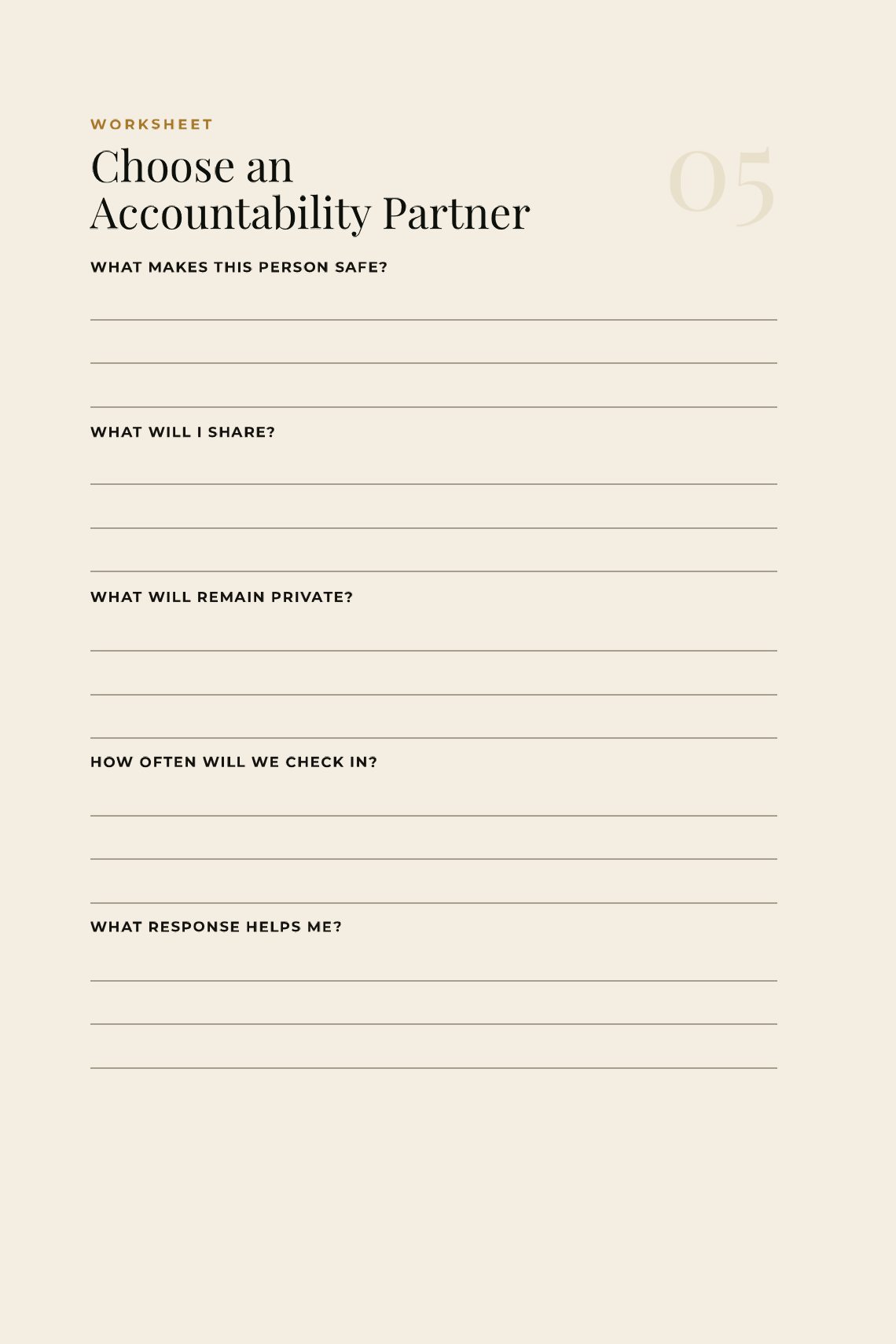
- One safe person, chosenWith the first message already drafted, and what you will and will not share.
- A phone routineWhere it sleeps, what it cannot open, and the time it goes away.
- A way backThe first five minutes after a slip, so one night does not become a week.
- Prayer that movesA routine of prayer and action that does not depend on how you feel.
- A calmer eveningA sleep time, one learning goal and one movement habit, so the hours are not empty.
- Words for hard conversationsFor a counsellor, a leader or a partner, without being shamed or blamed.
05 Try it tonight, free
Here is the first tool. Use it before you decide.
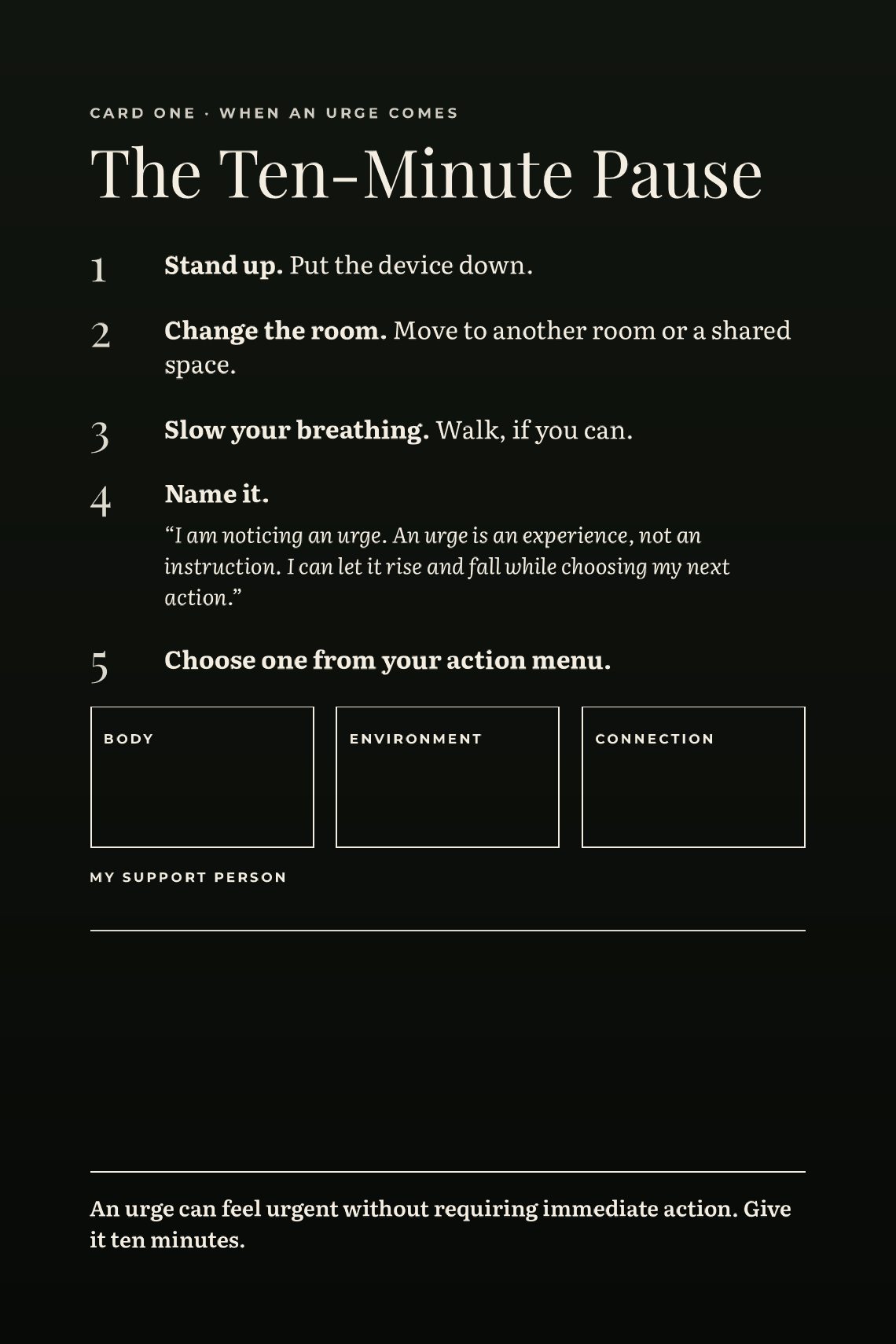
This is the Ten-Minute Pause, straight from the book. The next time an urge comes, do these five things in order.
- Stand up. Put the device down.
- Change the room. Move to another room or a shared space.
- Slow your breathing. Walk, if you can.
- Name it.
“I am noticing an urge. An urge is an experience, not an instruction. I can let it rise and fall while choosing my next action.”
- Choose one from your action menu, then give it ten minutes.
That is one page. The other 88 are what make it hold: why it works, how to prepare it in daylight, and what to do on the nights it does not.
06 What is inside
Eight things, and when you will reach for each.
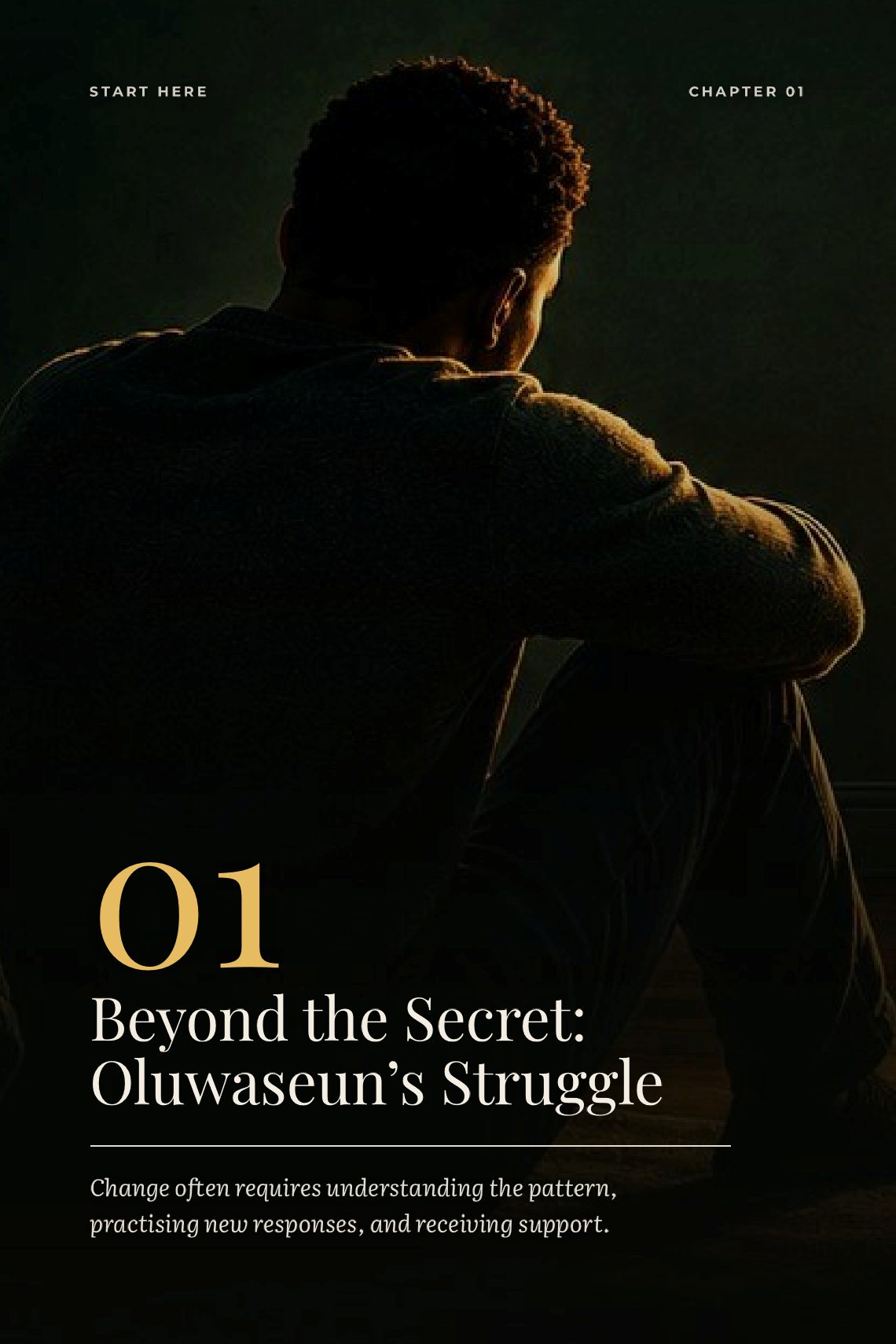
Item 1
The Guide, 15 chapters
Short, plain chapters you can read in ten minutes. Each one ends with one small action you can do the same day.
Reach for it: one chapter a day.
Item 2
Rescue Card: The Ten-Minute Pause
One page for the moment the urge arrives. Five steps, one sentence to say, and your own action menu.
Reach for it: the second the phone is in your hand.
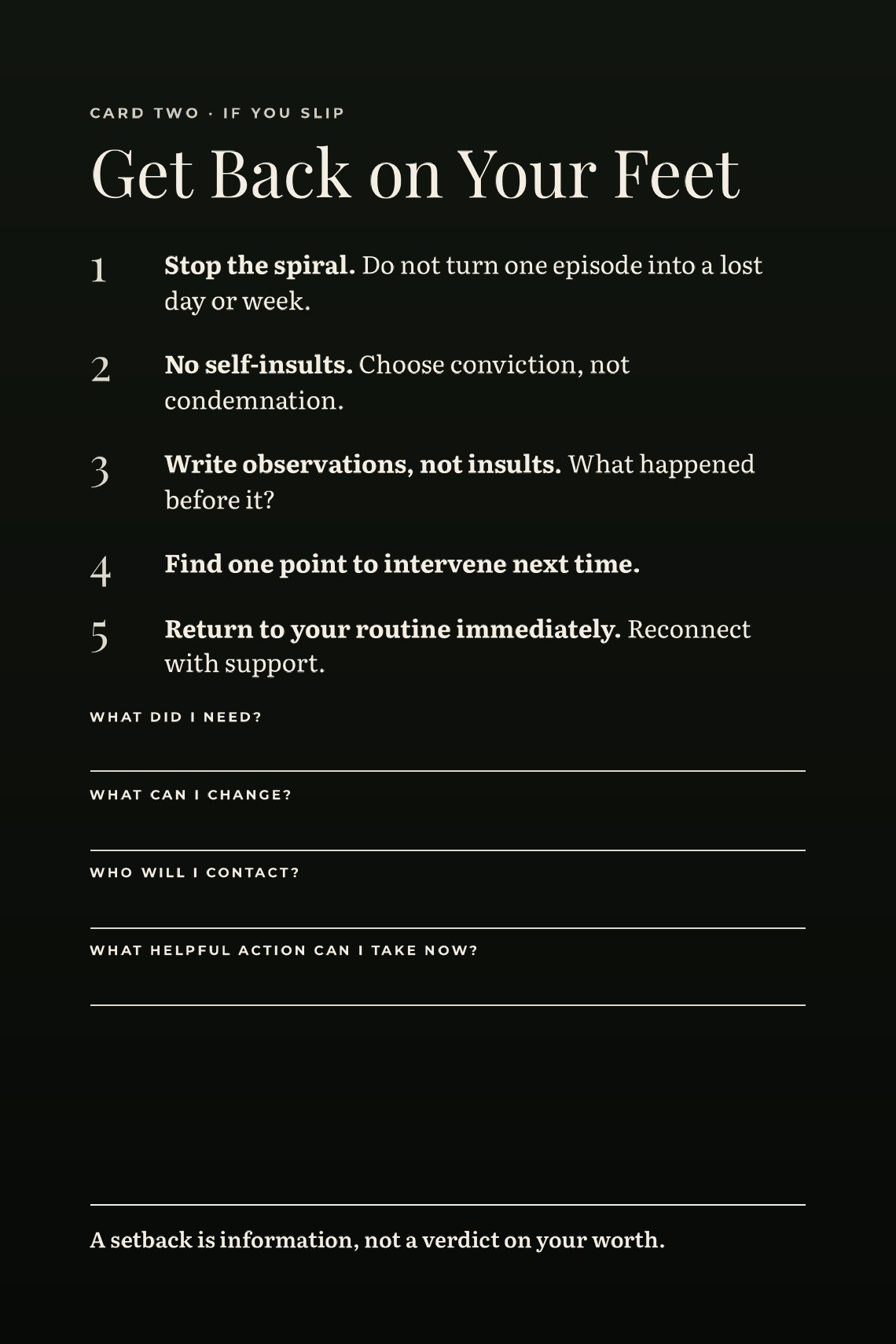
Item 3
Rescue Card: Get Back on Your Feet
For the day you slip. The first five minutes, written in advance, with no self-insults.
Reach for it: the morning after.
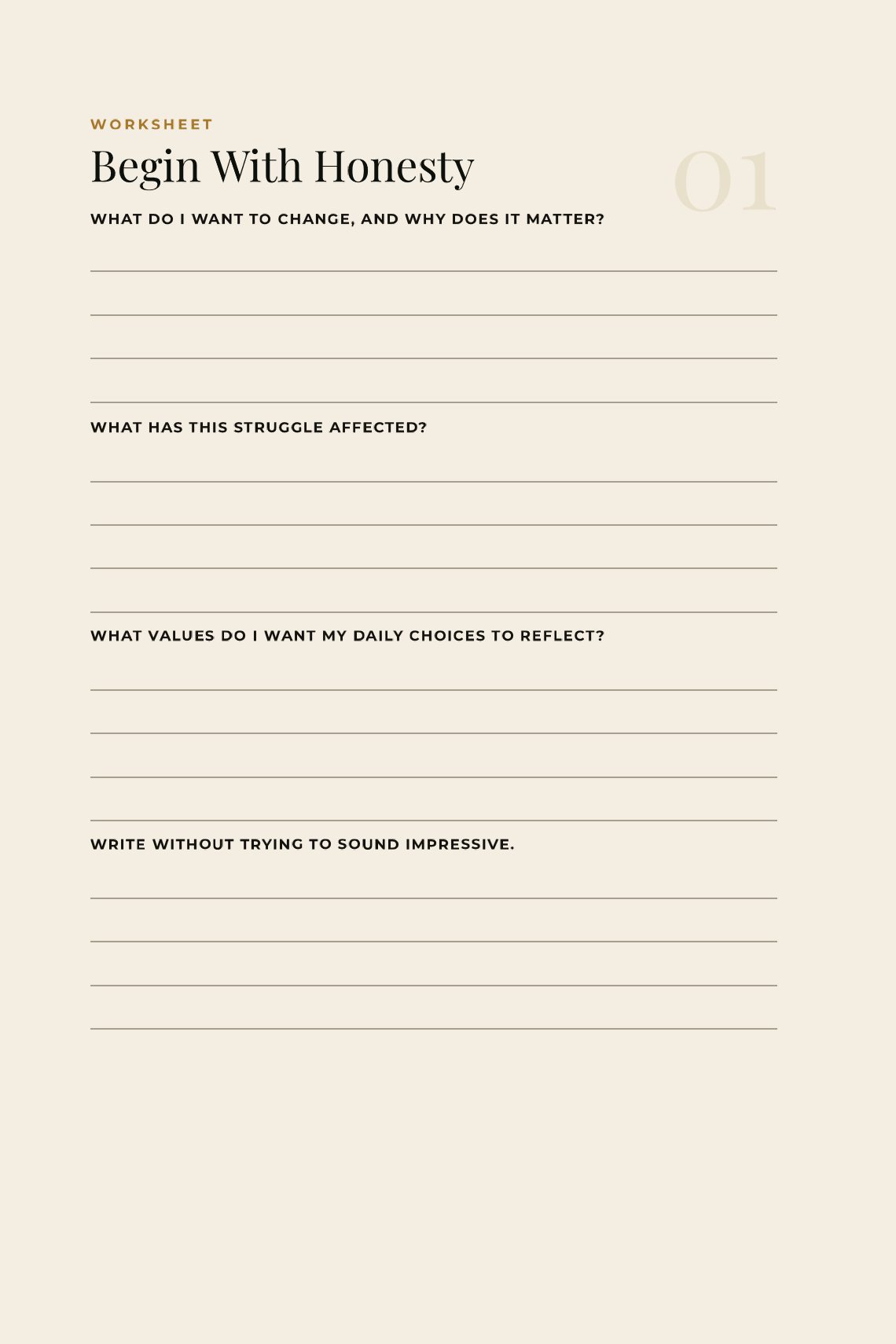
Item 4
29 printable worksheets
Pattern map, trigger plan, digital boundaries, accountability partner, loneliness plan, stress without escape, a letter to yourself after a setback, and more.
Reach for it: one a day, or when something is stuck.
Item 5
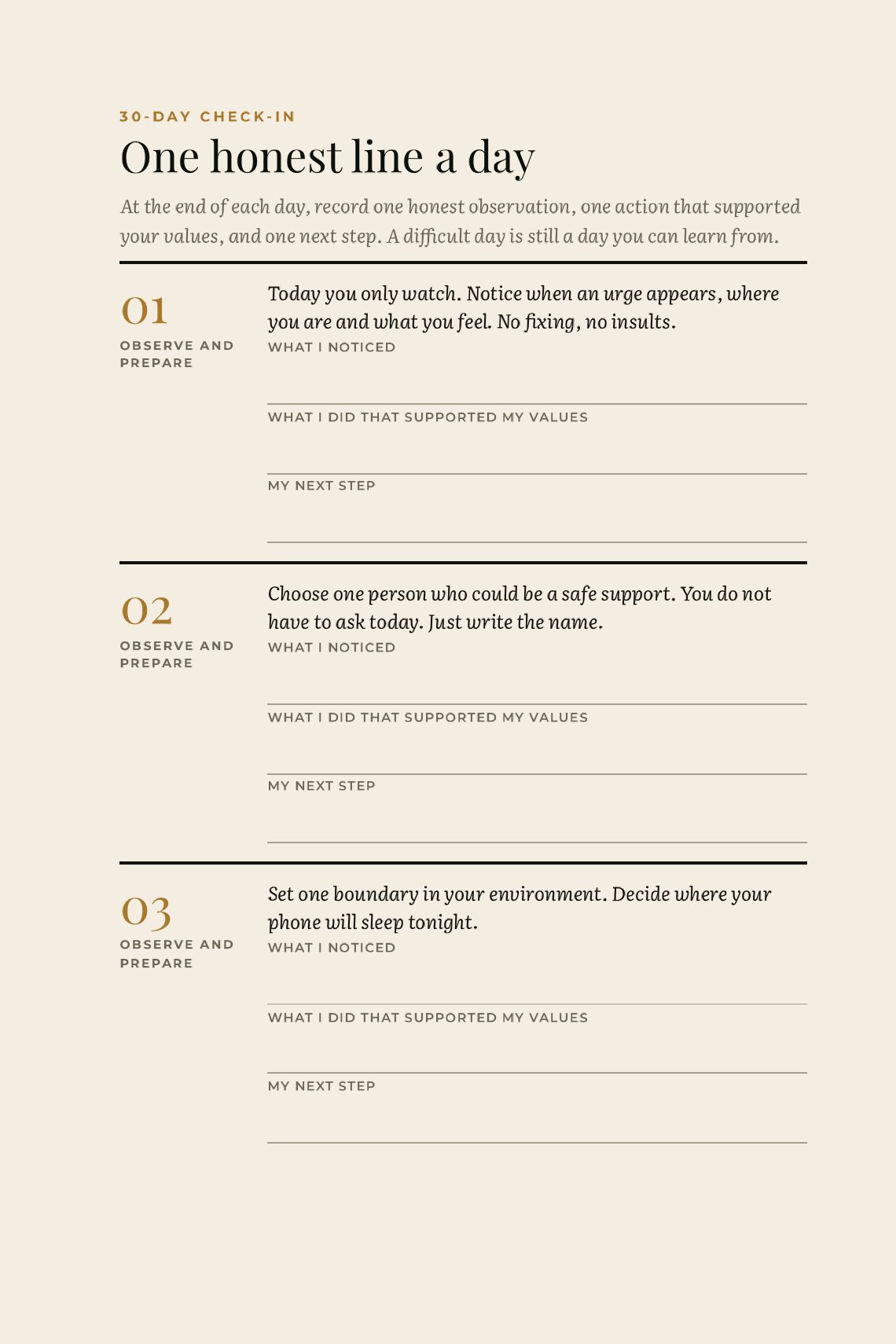
30-day check-in with daily prompts
A short prompt for every day, three lines to fill: what you noticed, what supported your values, your next step.
Reach for it: last thing before you sleep.
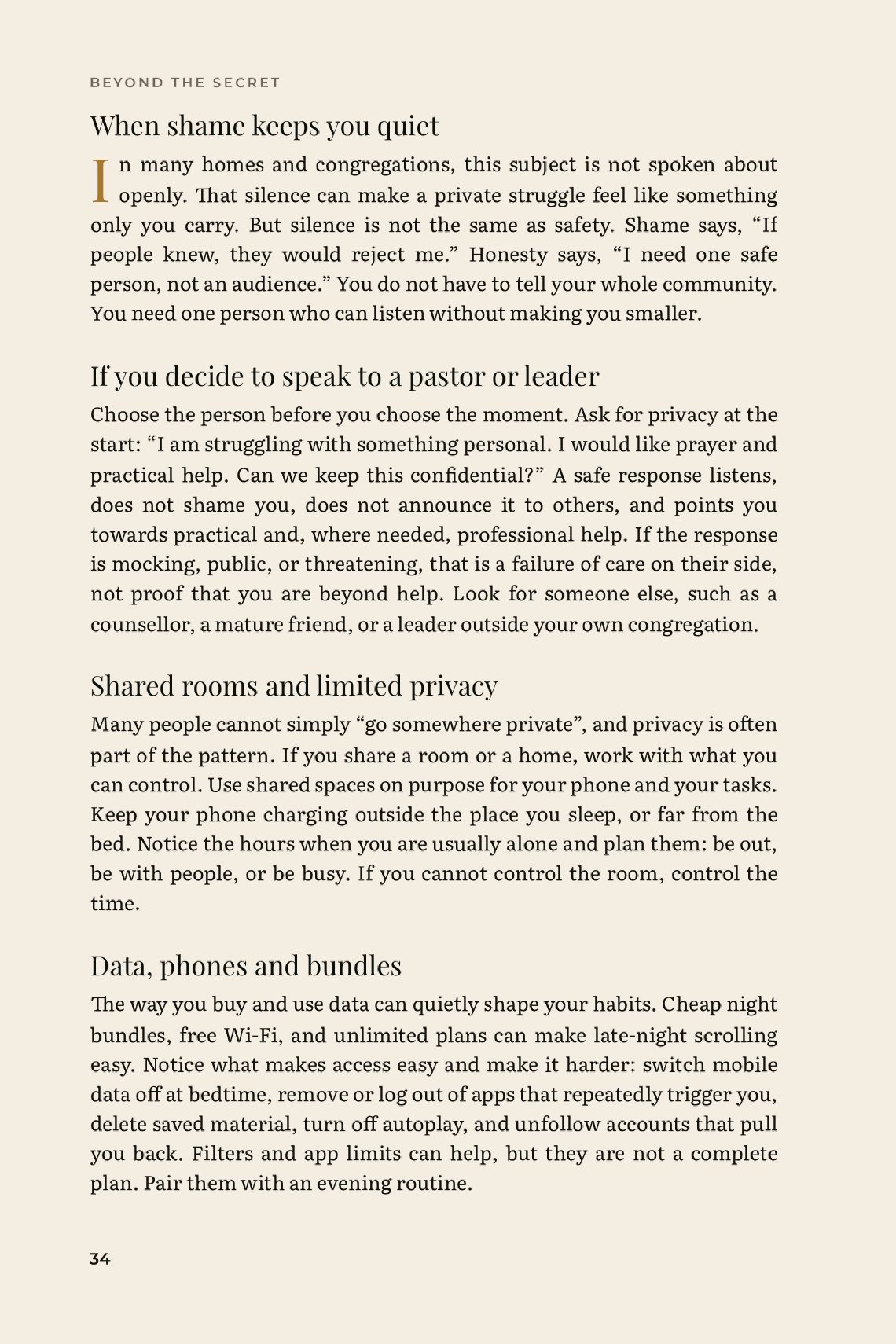
Item 6
The real-life chapter
Shame and silence, speaking to a pastor, shared rooms, data bundles, family and marriage pressure, and what to do when you cannot talk to anyone yet.
Reach for it: when advice assumes a life you do not have.
Item 7
What the experts say
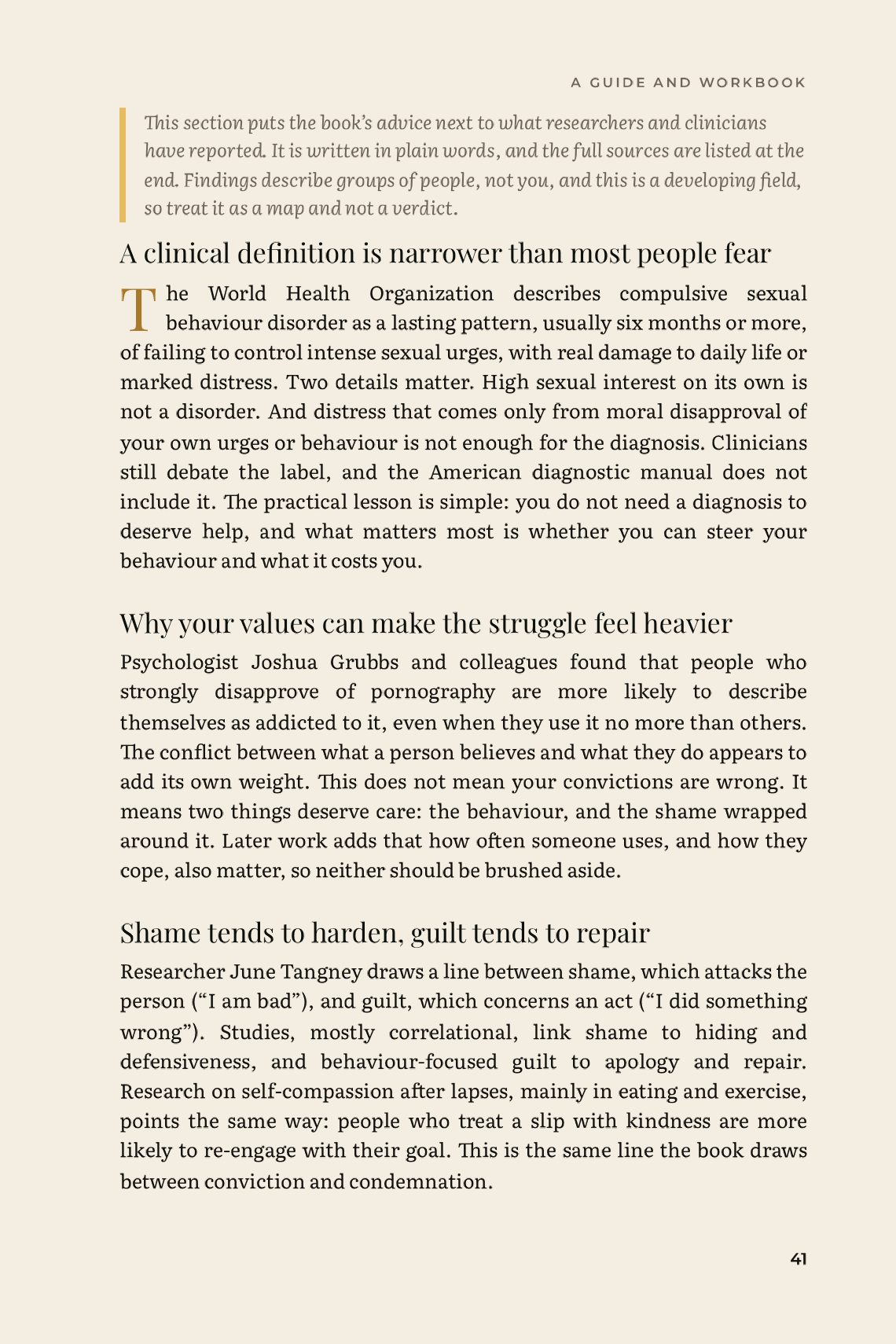
What researchers and clinicians report, in plain words, with every source listed at the back. So you know why the plan is built the way it is.
Reach for it: when you want to understand, not just obey.
Item 8
The discreet edition
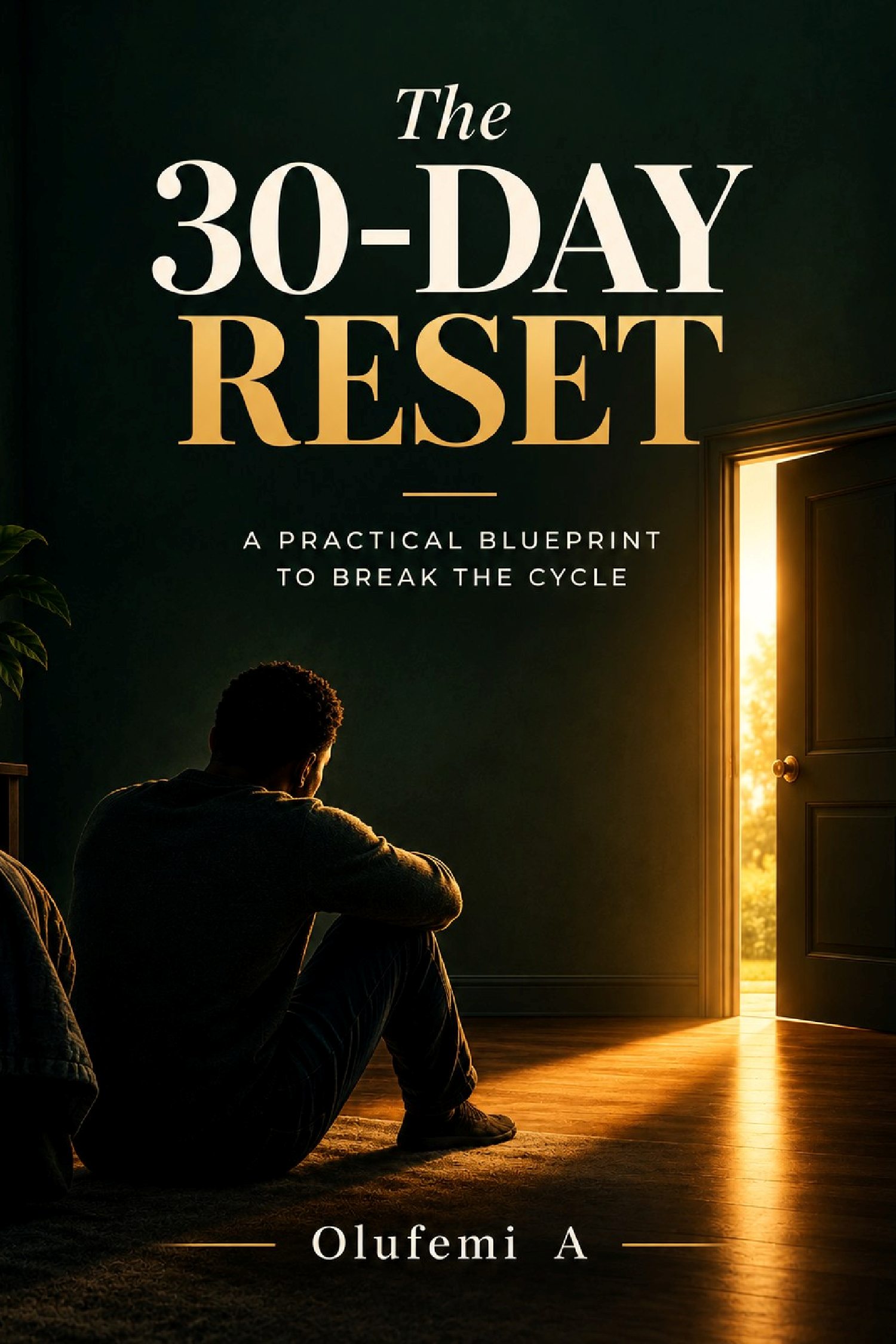
The same book, titled The 30-Day Reset, with a neutral cover. Keep the one you are comfortable seeing on your phone.
Reach for it: always. It is included.
07 Where to start
Depends how much time you have right now.
If you have ten minutes
Tonight
- Read “A Word Before We Begin”
- Fill in the action menu on the Ten-Minute Pause card
- Charge your phone outside the bedroom
If you have a week
Days 1 to 7
- Only watch: time, place, feeling, what came after
- Choose one safe person, even if you do not tell them yet
- Set one digital boundary
If you are ready for all of it
The full 30 days
- One chapter and one worksheet a day
- The daily check-in before you sleep
- A review on Day 30, and a plan for the next month
08 The person behind it
I wrote this sitting beside people, not from a distance.
Dear friend,
If you are reading this at night with a phone in your hand, I understand more than I can fit on a page.
I have counselled and mentored people for five years, and I have sat with many who carry exactly this. One man’s story opens this book so that you know you are not alone: he promised himself again and again that this time would be different, turned to church and to faith, and found that the struggle did not simply end when his life changed.
What I have learned is that another promise is not enough. Change needs a pattern you understand, new responses you practise, and a safe place to be honest. That is what I wrote down for you.
You do not have to tell anyone to begin. Day 1 only asks you to watch.
O
Olufemi A.
Author · 5 years counselling and mentoring09 What I keep hearing
This did not come from a shelf. It came from sitting with people.
I counsel and mentor a lot of people. I have been doing it for five years, with students, couples and young professionals. Whatever their story, I keep hearing the same things.
“I have tried everything. Nothing is working.”
They have tried all they know how to try, and they are exhausted. It is not effort they lack.
“Nobody knows.”
They have carried it alone for a long time, because the place where they most want to be honest feels like the least safe place to say it.
“I keep promising.”
They are not lazy and they are not fake. They have made the same sincere promise a hundred times, and a hundred times it has broken.
“Maybe God has given up on me.”
Not because they stopped believing, but because they are so tired of failing Him.
None of them needed a lecture. They needed a plan, one safe person, and somebody to say, “You are not beyond help.” That is what I tried to put into these pages: not a theory I picked up somewhere, but what I would put in your hands if you were sitting in front of me.
Where published research confirms what I see, I say so in the book and list the sources at the back: the World Health Organization, Joshua Grubbs, June Tangney, Alan Marlatt and Judith Gordon, and Phillippa Lally.
10 Thirty days from now
Now imagine the same night.
The house is quiet. The phone lights up in your hand. Same room, same hour. And something is different.
Not because the urge is gone. Because for the first time, you know what to do with it.
You stand up. You leave the room. You drink water. You breathe slowly and you count the ten minutes, because that is the plan. The urge climbs like a wave, and like a wave, it falls.
You are not a saint. You are not cured. But you are awake, and you are still standing. In the morning you write one honest line in the margin, and you do not feel like a hypocrite. You feel like a person who is learning how.
And on the night it still wins? You open Card Two. The first five minutes are already written for you.
11 The 30 days
Small enough for your worst day.
Days 1 to 7
Observe and prepare
“Today you only watch.”
Days 8 to 14
Practise the pause
“Stand up, move, breathe, wait.”
Days 15 to 21
Build the life you want
“Set the time your phone goes away.”
Days 22 to 30
Review and continue
“Day 30 is not a finish line.”
Included free
Four bonuses, in the same download.
The book is the plan. These make it easier to live it, safely and privately.
Bonus 1
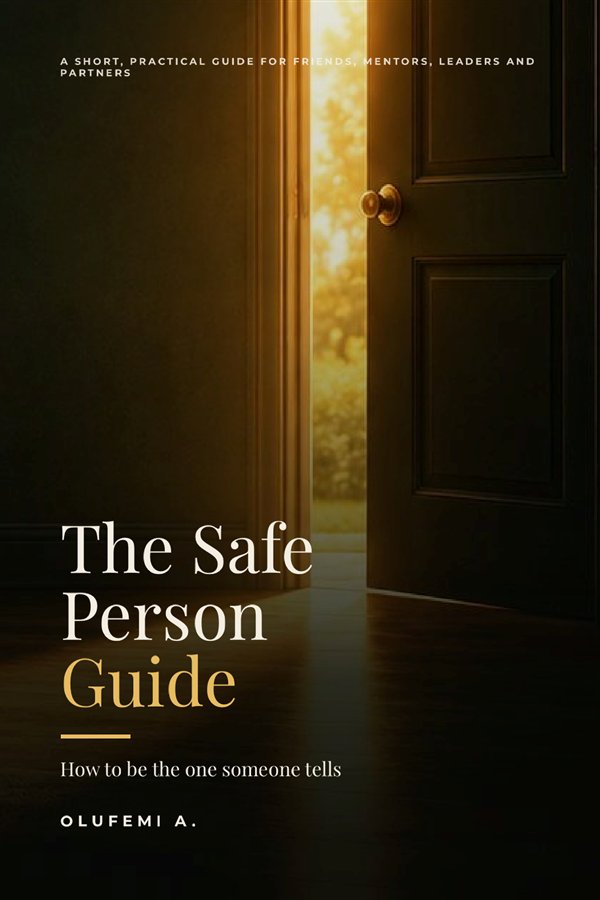
The Safe Person Guide
How to be the one someone tells. For the friend, mentor or partner you choose, or the one who chose you. What to say in the first minute, what to leave unsaid, and when to bring in a professional.
Bonus 2
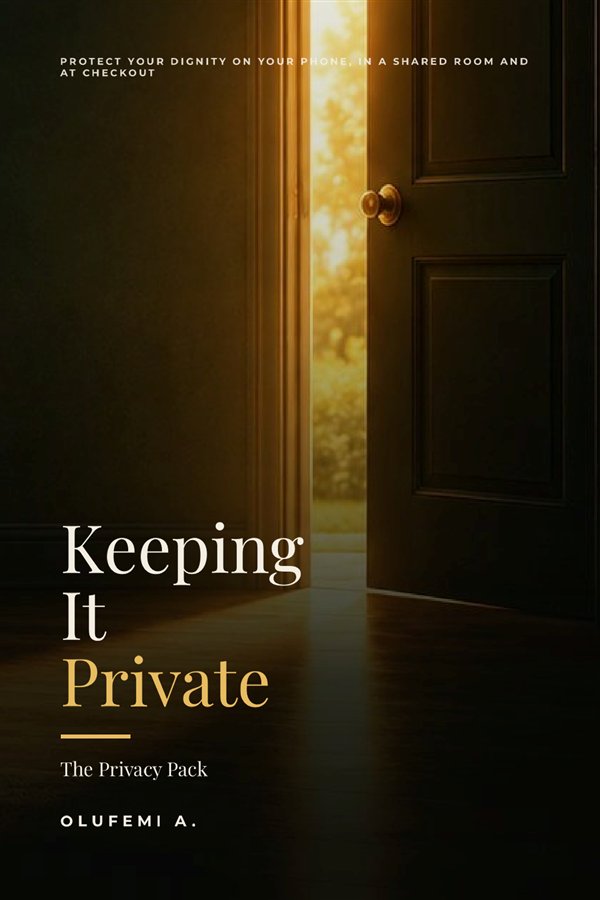
The Privacy Pack
Keep it private on your phone, in a shared room and at checkout, plus what to say if someone finds it. Without lying and without explaining everything.
Bonus 3
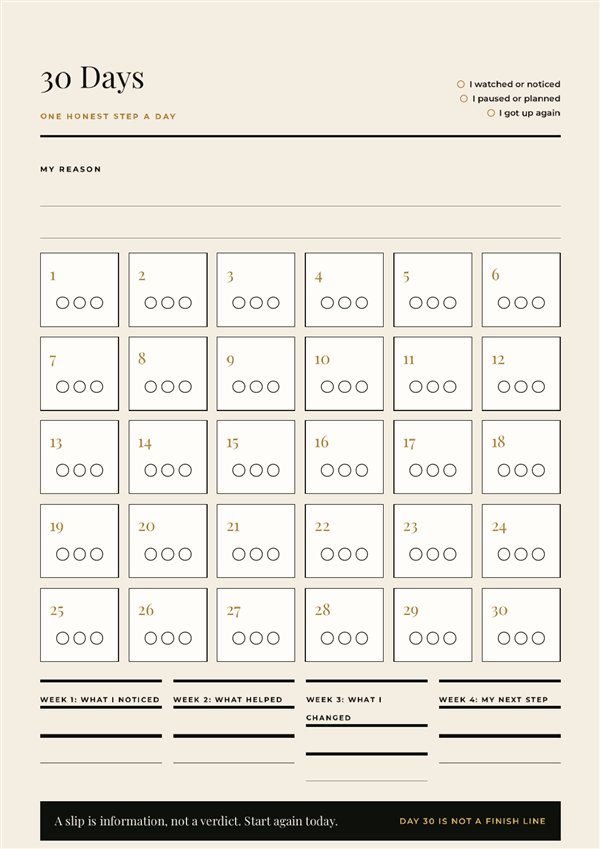
The 30-Day Wall Tracker
One printable page. Thirty days, three small circles a day, and four weekly lines. It looks like any ordinary chart.
Bonus 4
Three lock-screen cards
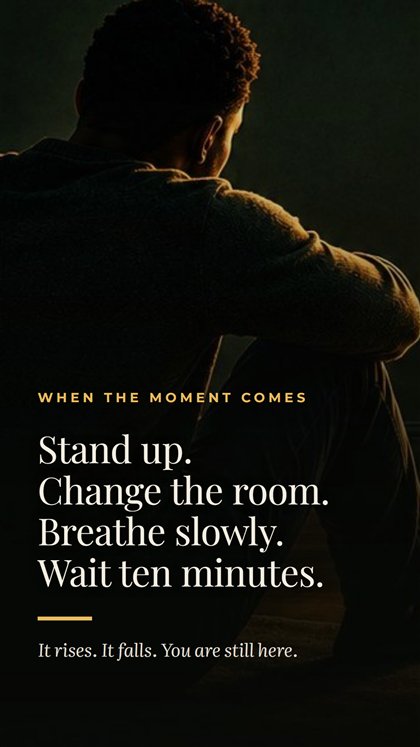
Wallpapers for the worst minute. “Stand up. Change the room. Breathe slowly. Wait ten minutes.” They never name the book or the habit, so they are safe on a lock screen.
12 The offer
Everything, for one payment.
- The Guide: 15 short, practical chapters
- 2 Rescue Cards: for the urge and for the slip
- 29 printable worksheets
- 30-day check-in with a daily prompt
- The real-life chapter: shared rooms, data, family, marriage
- What the experts say, with sources
- Two editions: Beyond the Secret and the discreet The 30-Day Reset
- Plus 4 free bonuses: Safe Person Guide, Privacy Pack, Wall Tracker, lock-screen cards
- Instant PDF for phone, tablet or computer
What I will not promise you
I will not promise you will never feel an urge again. Nobody honest can. I will not promise a miracle in seven days.
I can promise a clear plan, one small step a day, tools for the worst minute of the night, and a way back when you fall, with no shame in any of it.
13 Questions
Before you decide.
Is this therapy or medical advice?
No. It is an educational, faith-based guide. If the behaviour feels out of control, causes serious distress or affects your work or relationships, the book encourages you to see a qualified professional and helps you prepare for that conversation.
Will it work for me?
No book can promise a cure, and this one does not. It gives you a method, daily steps and tools you can use straight away. Progress looks different for everyone: faster recovery after a slip, more honest check-ins and fewer hours lost all count.
Do I have to tell anyone?
No. You can do the whole book privately. When you are ready, it helps you choose one safe person and shows you how to ask for support without being shamed.
Is it only for Christians?
It is faith-centred and written from a Christian perspective, with prayer and Scripture. The practical tools, such as the pause, the worksheets and the daily prompts, are useful whatever your background.
I am married, or single. Does it still apply?
Yes. There is a chapter on love, marriage and honest intimacy, and everything else applies to anyone.
What exactly do I receive?
One instant download: a single zip file containing both editions of the book, the three bonus guides and the lock-screen cards. Tap the zip to open it (on iPhone use the Files app; on Android tap it and choose Extract). A page called 00_START_HERE inside walks you through it. Read on your phone, tablet or computer, and print the worksheets if you prefer paper.
Is my purchase private?
The discreet edition exists so the file on your phone does not announce itself. Checkout is handled securely by Selar.
Tonight, don't type “I'm fine.” Start Day 1.
You have carried this long enough. Not another promise. Thirty days, one honest step at a time, beginning with simply watching.
Start my 30 days · ₦5,000Instant PDF · discreet cover included